Thursday, 10 October 2019

WHY 9 IS MAGICAL NUMBER?

9 is a magical number. I can prove it. Just read carefully –
Table of 9 is –:
 09
18
27
36
45
54
63
72
81
90
Now, add the two digit number in the table of 9
Foe ex –       0 + 9 = 9
                     1 + 8 = 9
                     2 + 7 = 9
                     3 + 6 = 9
                     4 + 5 = 9
                     5 + 4 = 9
                     6 + 3 = 9
                     7 + 2 = 9
                     8 + 1 = 9
                     9 + 0 = 9
So, in all times we add numbers it comes 9.
Now, you can think why 9 is magical number.

Thursday, 29 August 2019

What will happen if you subtract your age from................

There is a magical trick in mathematics. Just follow steps as directed :–
1. Subtract your age from 78. For example my age is 33. So, 78 – 33 = 45
2. Then, add 1941 from the resulting answer. For example 1941 + 45 = 1986
3. Then, you will got your birth year.

Sunday, 25 August 2019

COLLATZ CONJECTURE

Collatz Conjecture is also known as 3n + 1 problem. It is the biggest problem for mathematicians to solve it.
Take any natural number n. If  n is even, divide it by 2 to get n/2, if n is odd multiply it by 3 and add 1 to obtain 3n +1. Repeat this process indefinitely. the conjecture is that no matter what number you start with, you will always eventually reach 1.
Paul Erdos said about the collatz conjecture :
"Mathematics is not yet ready for such problems."

Is there any reason to think that a proof of the Collatz Conjecture would be complex rather that simple

Tuesday, 13 August 2019

PROVE THAT 6 – 3 = 6

                                6 – 3 = 6
Proof: It is very simple question,
                                         just turn 6 by 180° so we get 9
                       hence, 9 – 3 = 6
                                        Hence Proved

Sunday, 11 August 2019

If the distance between the top of two trees 20 m and 28 m tall is 17 m, then the horizontal distance between the trees is :

Solution :       Let AB and CD be two trees such that AB = 20 m, CD = 28 m & BD = 17 m
                                           

Draw BE parallel to CD. Then, ED = 8 m.
By Pythagoras theorem,


Saturday, 3 August 2019

If angle A and angle B are acute angles such that cos A = cos B, then show that angle A = angle B.

It is given that, cos A =  cos B
                                                                                 
       Therefore, AC/AB = BC/AB
                        By Cancelling AB
        we get, AC = BC
        As we know angles opposite to equal sides are equal.
                        angle A = angle B

                    HENCE PROVED

Thursday, 25 July 2019

EUCLID'S AXIOMS AND POSTULATES

AXIOMS

  1. Things which are equal to same thing are equal to one another.
  2. If equals are added to equals, the wholes are equal.
  3. If equals are subtracted from equals, the remainders are equal.
  4. Things which coincide with one another are equal to one another.
  5. The whole is greater than a part.
  6. Things which are double of the same things are equal to one another.
  7. Things which are halves of the same things are equal to one another.

POSTULATES


  1. A straight line may be drawn from any one point to any other point.
  2. A terminated line can be produced infinitely.
  3. A circle can be drawn with any centre and any radius.
  4. All right angles are equal to one another.
  5. If a straight line falling on two straight lines makes the interior angles on the same side of it taken together less than two right angles, then two straight lines, if produced infinitely, meet on that side on which the sum of angles is less than two right angles.


FOR ANY QUERY CONTACT US OR COMMENT BELOW.

Friday, 19 July 2019

WHAT IS ADDITIVE INVERSE?

Definition

The additive inverse of a number is what you add to a number to create the sum of zero. So in other words, the additive inverse of x is another number, y, as long as the sum of x + y equals zero. The additive inverse of x is equal and opposite in sign to it (so, y = -x or vice versa). For example, the additive inverse of the positive number 5 is -5. That's because their sum, or 5 + (-5) = 0.
What about the additive inverse of a negative number? Using the same approach, if x is a negative number, then its additive inverse is equal and opposite in sign to it. This means that the additive inverse of a negative number is positive. For instance, if x equals -12, then its additive inverse is y = 12. We can verify that the sum of x + y equals zero, since when x = -12 and y = 12, we have -12 + 12 = 0.
It should be noted that the additive inverse of 0 is 0. Zero is the only real number, which is equal to its own additive inverse. It is also the only number for which the equation x = -x is true.

Graphical Representation

We can also think of the additive inverse visually. Let's consider the real number line, which is usually drawn horizontally, with 0 near the middle, the negative numbers to its left, and the positive numbers on the right. Two numbers of opposite sign fall on either side of 0 on the number line at equal distance.
Once we place the point corresponding to a number x on the number line, we know that the additive inverse, or -x, will fall on the opposite side of the number line with respect to 0. In fact, the point 0 is the midpoint between x and its additive inverse -x. For example, when x = 5, its additive inverse is -5.
A number and its additive inverse are equidistant from the 0
Number line
It is clear to see that the point 0 is the midpoint of the segment between -5 and 5.


For any query comment below or contact us.

Tuesday, 16 July 2019

WHAT IS MULTIPLICATIVE INVERSE?

Multiplicative Inverse is a another word for Reciprocal.

What you multiply by a number to get 1 

Example: 8 × (1/8) = 1

In other words: when we multiply a number by its "Multiplicative Inverse" we get 1.

But not when the number is 0 because 1/0 is undefined!


For any query comment or contact us.

Sunday, 7 July 2019

WHAT IS TRIGONOMETRY?

INTRODUCTION

In this chapter, we intend to study an important  branch of mathematics called '' TRIGONOMETRY''.
The word TRIGONOMETRY is derived from the Greek words: (i) trigonon and, (ii) metron. The word trigonon means a triangle and metron means measure. Hence, trigonometry means the science of measuring triangles.

TRIGONOMETRIC RATIOS AND ITS FORMULAS

  Ratios           Formulas
1. sinq = Perpendicular/Hypotenuse
2. cosineq = Base/Hypotenuse
3. tangentq = Perpendicular/Base                                                              
4. cosecantq = Hypotenuse/Perpendicular
5. secantq = Hypotenuse/Base                                               
6. cotangentq = Base/Perpendicular

 The perpendicular side is that the side which is front of the angle that we talk about.The hypotenuse side is the side front of right angle. and the remaining side is the base.


IDENTITIES

sin(θ) = 1/csc(θ)
cos(θ) = 1/sec(θ)
tan(θ) = 1/cot(θ)

csc(θ) = 1/sin(θ)
sec(θ) = 1/cos(θ)
cot(θ) = 1/tan(θ)

cot(θ) = cos(θ)/sin(θ)

                                       sin2 θ + cos2 θ = 1                              

                                              sin2 θ = 1 − cos2 θ                                   
                                              cos2 θ = 1 − sin2 θ                                   
                                              tan2 θ + 1 = sec2 θ                                   
                                              tan2 θ = sec2 θ − 1                                   
                                              cot2 θ + 1 = csc2 θ                                   
                                              cot2 θ = csc2 θ − 1                                   
.

For any query comment below or contact us. 

Saturday, 29 June 2019

Prove that root 2 irrational.


Let's suppose √2 is a rational number. Then we can write it √2  = a/b where ab are whole numbers, b not zero.
We additionally assume that this a/b is simplified to lowest terms, since that can obviously be done with any fraction. Notice that in order for a/b to be in simplest terms, both of a and b cannot be even. One or both must be odd. Otherwise, we could simplify a/b further.
From the equality √2  = a/b it follows that 2 = a2/b2,  or  a2 = 2 · b2.  So the square of a is an even number since it is two times something.
From this we know that a itself is also an even number. Why? Because it can't be odd; if a itself was odd, then a · awould be odd too. Odd number times odd number is always odd. Check it if you don't believe me!
Okay, if a itself is an even number, then a is 2 times some other whole number. In symbols, a = 2k where k is this other number. We don't need to know what k is; it won't matter. Soon comes the contradiction.
If we substitute a = 2k into the original equation 2 = a2/b2, this is what we get:
2=(2k)2/b2
2=4k2/b2
2*b2=4k2
b2=2k2
This means that b2 is even, from which follows again that b itself is even. And that is a contradiction!!!
WHY is that a contradiction? Because we started the whole process assuming that a/b was simplified to lowest terms, and now it turns out that a and b both would be even. We ended at a contradiction; thus our original assumption (that √2 is rational) is not correct. Therefore √2 cannot be rational.

Wednesday, 26 June 2019

Pi

Pi,

 in mathematics, the ratio of the circumference of a circle to its diameter. The symbol for pi is π. The ratio is the samefor all circles and is approximately 3.1416. It is of great importance in mathematics not only in the measurement of the circlebut also in more advanced mathematics in connection with such topics as continued fractions, logarithms of imaginarynumbers, and periodic functions. Throughout the ages progressively more accurate values have been found for π; an earlyvalue was the Greek approximation 3 1-7, found by considering the circle as the limit of a series of regular polygons with anincreasing number of sides inscribed in the circle. About the mid-19th cent. its value was figured to 707 decimal places andby the mid-20th cent. an electronic computer had calculated it to 100,000 digits. Although it has now been calculated to some2.6 trillion digits, the exact value of π cannot be computed. It was shown by the German mathematician Johann Lambert in1770 that π is irrational and by Ferdinand Lindemann in 1882 that π is transcendental; i.e., cannot be the root of anyalgebraic equation with rational coefficients. The important connection between π and e, the base of natural logarithms, wasfound by Leonhard Euler in the famous formula eiπ=−1, where i=√−1.


Pi


π, a letter of the Greek alphabet used in mathematics to denote a particular irrational number—the ratio of the circumferenceto the diameter of a circle. The symbol was probably adopted from the Greek word for “circumference,” or “periphery.”Although it came into general use after a paper by L. Euler in 1736, it was first used by the British mathematician W. Jones in1706. Like all irrational numbers, π is an infinite nonrepeating decimal fraction:
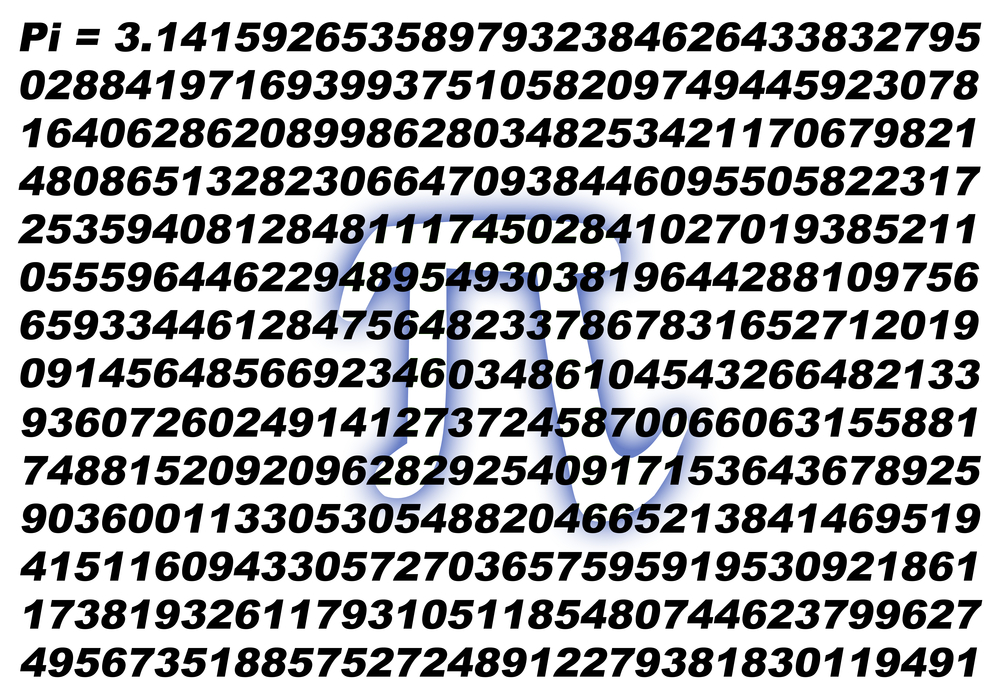
π = 3.141592653589793238462643…
The requirements of practical calculations involving circles and circular solids long ago made it necessary to findapproximations of π by rational numbers. In the second millennium B.C., ancient Egyptian computations of the area of a circlemade use of the approximation π ≈ 3, or, more precisely, π ≈ (16/9)23.16049.… In the third century B.C., Archimedes found,by comparing the circumference of a circle to regular inscribed and circumscribed polygons, that π is between the values
The second value is still used in calculations that do not require great accuracy. In the second half of the fifth century, theChinese mathematician Tsu Ch’ung-chih obtained the approximation 3.1415927, which much later (16th century) was alsofound in Europe. This approximation is exact for the first six decimal places.
The search for a more exact approximation of π continued in later periods. For example, in the first half of the 15th century,al-Kashi calculated π to 17 places. In the early 17th century, the Dutch mathematician Ludolph van Ceulen obtained 32places. For practical needs, however, it is sufficient to have values for π and the simplest expressions in which π occurs toonly a few decimal places; reference works usually give four- to seven-place approximations for π, 1/π, π2and log π.
The number π appears not only in the solution of geometric problems. Since the time of F. Vieta (16th century), the limits ofcertain arithmetic sequences generated by simple rules have been known to involve π. An example is Leibniz’ series (1673-74)
This series converges extremely slowly. There exist series for calculating π that converge much more rapidly. An example isthe formula
where the values of the arc tangents are calculated by means of the series
The formula was used in 1962 for a computer calculation of π to 100,000 places. This type of calculation is of interest inconnection with the concept of random and pseudorandom numbers. Statistical processing has shown that this set of100,000 digits exhibits many features of a random sequence.
The possibility of a purely analytic definition of π is of fundamental importance for geometry. Thus, in non-Euclideangeometry π also occurs in some formulas but is no longer the ratio of the circumference to the diameter of a circle, for theratio is not a constant in non-Euclidean geometry. The arithmetic nature of π was finally clarified by analytic means, amongwhich a crucial role was played by the remarkable Euler formula e2πi = 1, where e is the base of the natural system oflogarithms and Pi.
At the end of the 18th century, J. H. Lambert and A. M. Legendre proved that π is irrational. In 1882 the Germanmathematician F. Lindemann showed it to be transcendental—that is, it cannot satisfy any algebraic equation with integralcoefficients. The Lindemann theorem conclusively established that the problem of squaring the circle cannot be solved bymeans of a compass and straightedge.

Special fact on Pi

The birthday of pi is also celebrated on 14th of march as pi day.
Pi is irrational no. it can never be end,
Proof
 It is still after.



